Why this event matters
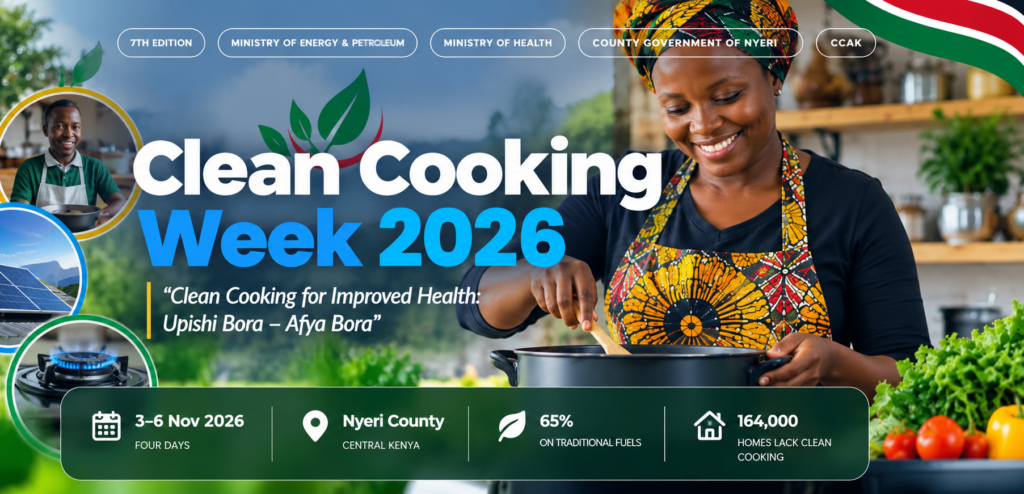
Clean Cooking Week 2026 will take place in Nyeri County, Kenya, from 3–6 November, bringing together government representatives, businesses, civil society organisations, researchers, the media and communities to discuss ways to advance clean cooking.The event is organised by the State Department for Energy in collaboration with the Ministry of Health, the County Government of Nyeri and the Clean Cooking Association of Kenya (CCAK).
Why Clean Cooking Week 2026 Matters
- Improving public health: Highlighting the relationship between cleaner cooking and reduced exposure to harmful household air pollution.
- Strengthening policies: Supporting coordinated action through national and county clean cooking strategies.
- Exploring financing and investment: Discussing funding, partnerships and investment opportunities that can help expand access.
- Showcasing technology: Demonstrating modern cooking fuels and technologies through participating companies, entrepreneurs and partners.
- Reaching communities: Promoting public awareness and community engagement around clean cooking options.
- Supporting inclusion: Featuring sessions on gender equality, disability and social inclusion.
- Promoting environmental conservation: Including tree planting and ecosystem restoration activities.
These areas reflect the programme’s intention to connect policy discussions with practical solutions and community experiences.
What to Expect at Clean Cooking Week 2026
The programme will begin with participant arrivals and exhibition set-up on 3 November, ahead of the main activities. Awareness campaigns and media publicity are scheduled for the lead-up to the event.
Across the four days, planned activities include the launch of national and county clean cooking strategies, high-level panels on financing and investment, and live demonstrations of modern cooking fuels.
Participants will also engage in community sensitisation and corporate social responsibility activities. Field visits are planned to local clean cooking initiatives, institutions and community end users, offering opportunities to learn from experiences on the ground.
The programme further includes tree planting and climate action activities, alongside sessions dedicated to gender equality, disability and social inclusion. According to the organisers, the agenda is indicative and may change.
Why Collaboration Matters
Expanding access to clean cooking requires contributions from several sectors. Government institutions can help shape policies and support implementation, while businesses and entrepreneurs can develop and distribute technologies that meet different cooking needs. Financial institutions and development partners can also explore ways to make equipment and fuel more affordable.
Community organisations and researchers play an important role in understanding the experiences of households and identifying gaps between available solutions and people’s everyday needs. Their perspectives can help inform decisions about which approaches are practical and sustainable.
By bringing these groups together, Clean Cooking Week 2026 aims to create space for knowledge-sharing, partnerships and discussions on how to accelerate the adoption of cleaner cooking solutions in Kenya.
The Link Between Clean Cooking and Public Health
Household air pollution remains a public health concern, particularly for people who spend considerable time preparing meals in homes that rely on polluting cooking fuels and technologies. Exposure to smoke from these sources can contribute to respiratory and cardiovascular diseases, with women and children often facing significant exposure.
The World Health Organization identifies cleaner household energy as an important measure for reducing exposure to household air pollution. However, the transition depends on more than awareness of the health risks. Households need cooking options that are affordable, reliable, safe and suitable for their daily needs.
Clean Cooking Week 2026 places health at the centre of its discussions, creating an opportunity for stakeholders to consider how cleaner cooking technologies can become more accessible to households and institutions.
Bringing Policy and Household Needs Together
Expanding clean cooking access involves more than introducing a new stove or fuel. Households also consider affordability, availability, convenience, safety and whether a technology suits their everyday cooking needs.
Discussions on financing, investment, partnerships and research can help stakeholders examine some of the factors that shape access. Meanwhile, demonstrations and field visits can connect those discussions with the experiences of households and institutions using clean cooking solutions.
Bringing public institutions, private companies, civil society, researchers and communities together provides an opportunity to share knowledge and explore ways to address these challenges.
For programme updates and further information, visit the official Clean Cooking Week 2026 website.
As the event approaches, its planned discussions, demonstrations and outreach activities will provide a platform for stakeholders to explore practical ways of improving access to cleaner cooking in Kenya.
Read more clean cooking stories, insights and solutions on the Fuel The Shift website .
Related Fuel the Shift Stories



You Might Also Be Interested In
Cabinet Secretary Ministry of Energy & Petroleum
Cabinet Secretary Ministry of Health
Governor County Government of Nyeri
Chief Executive Clean Cooking Association of Kenya
Private Sector Innovators Burn Manufacturing · Koko Networks
The full agenda will be published once confirmed by the organiser. In the meantime, delegate registration includes access to all plenary sessions, the investor roundtable track, and the closing networking reception.
Additional information
Delegate registration includes access to all plenary sessions. Group rates may be available for organisations registering 3 or more delegates — contact the organiser directly for details.